Indigenous Artwork
House of Learning
First Floor
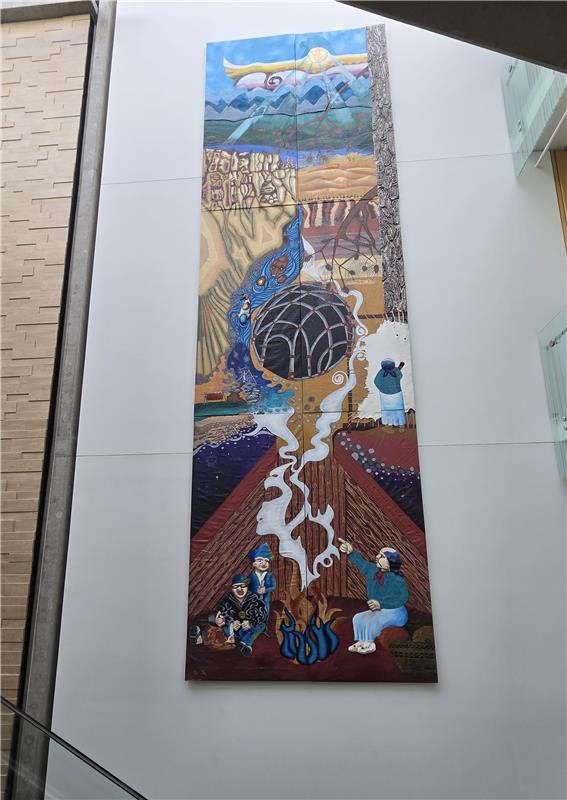
House of Learning Mural
Hangs between 2nd and 4th floor.
Artists Leonard George and Shannon Kilroy
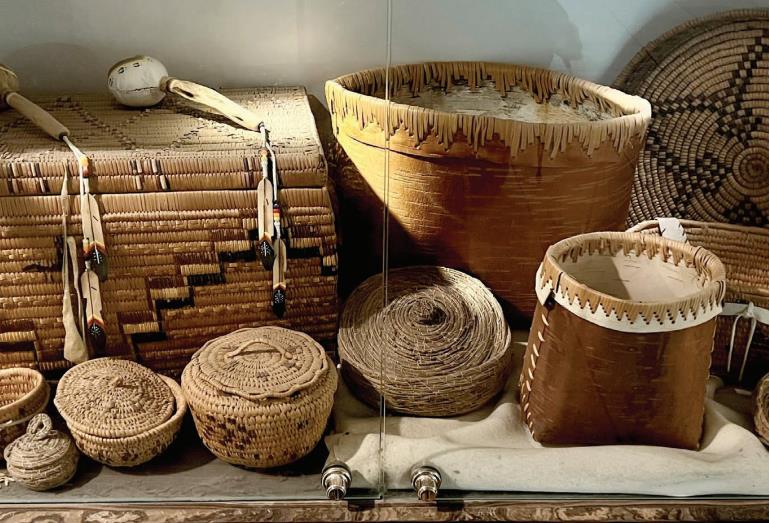
Baskets
Traditional Interior Salish Pine Needle, Cedar root, birch bark baskets and rattles.
Artist Mandy Brown
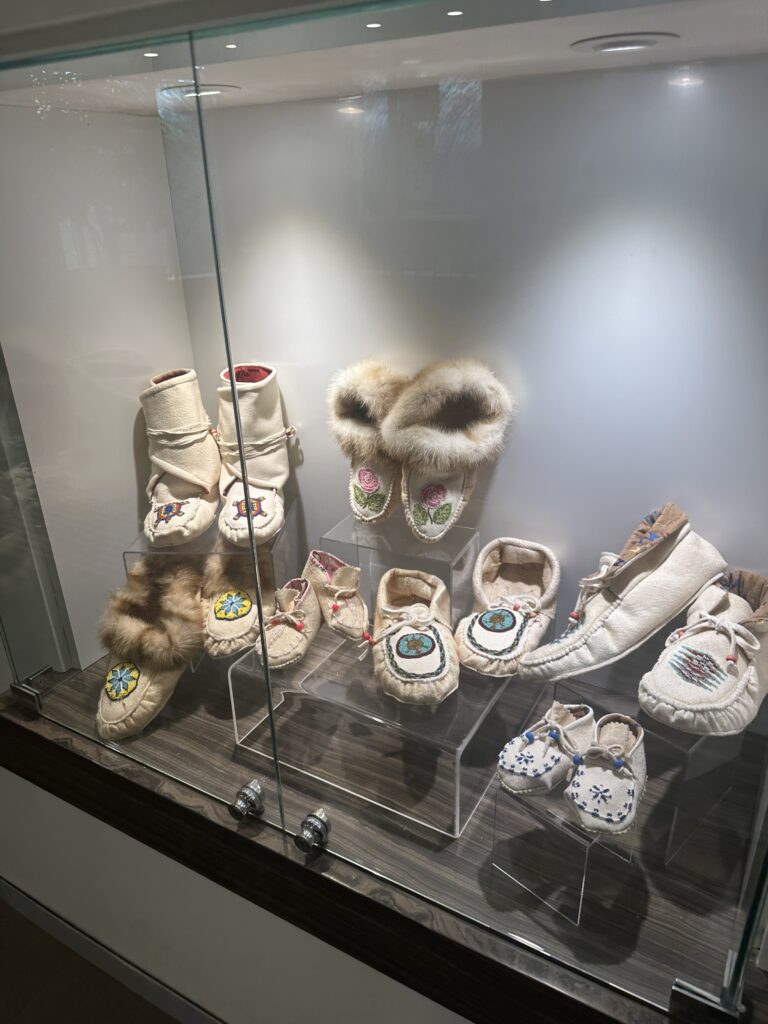
Moccasins
Moccasins made of deer hide, beadwork, and embroidery. KPMG Gallery HL 1st floor.
Artist Nancy Saddleman (Upper Nicola Band)
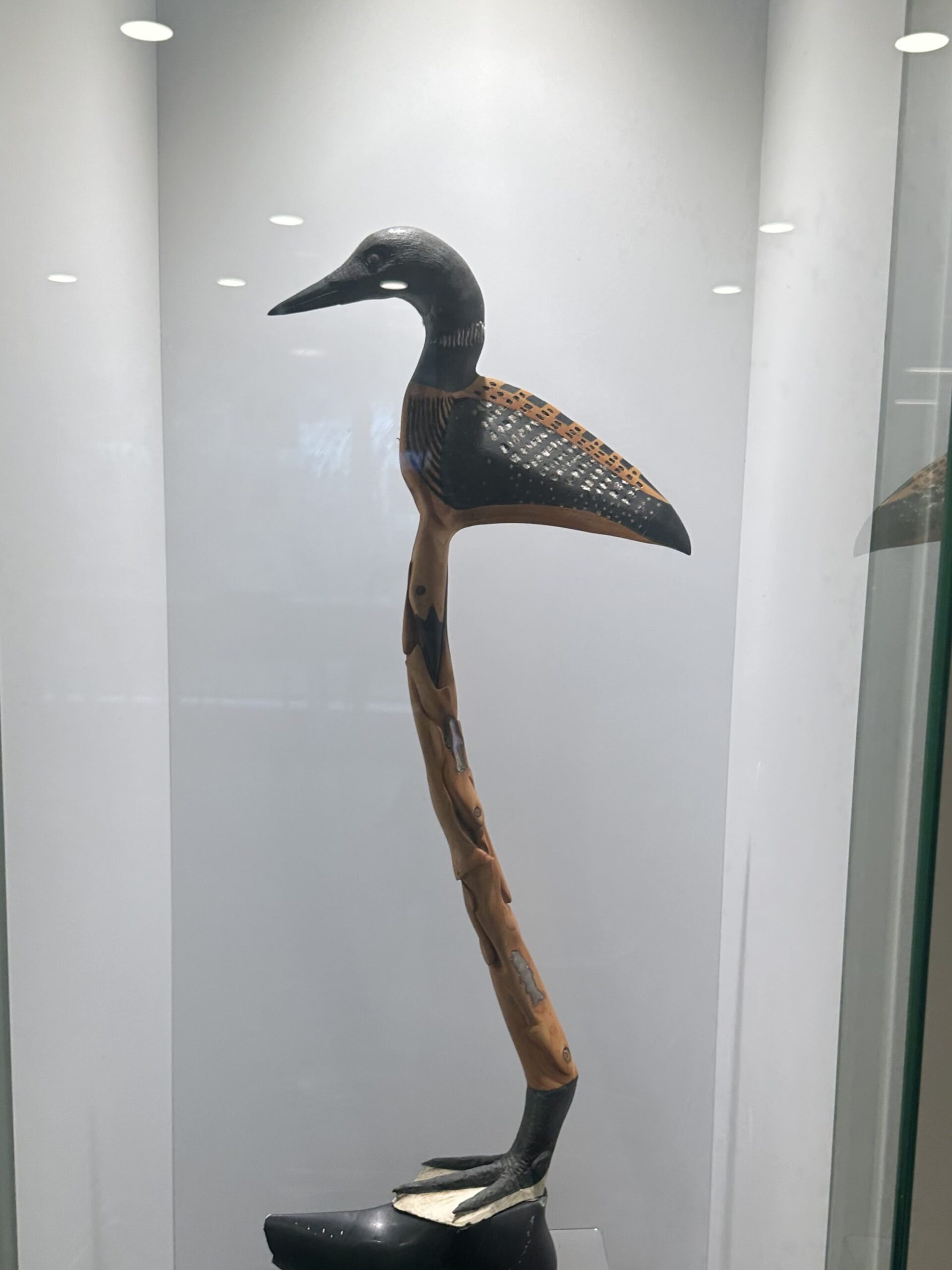
Hear, in Silence
Artist Daniel Tom
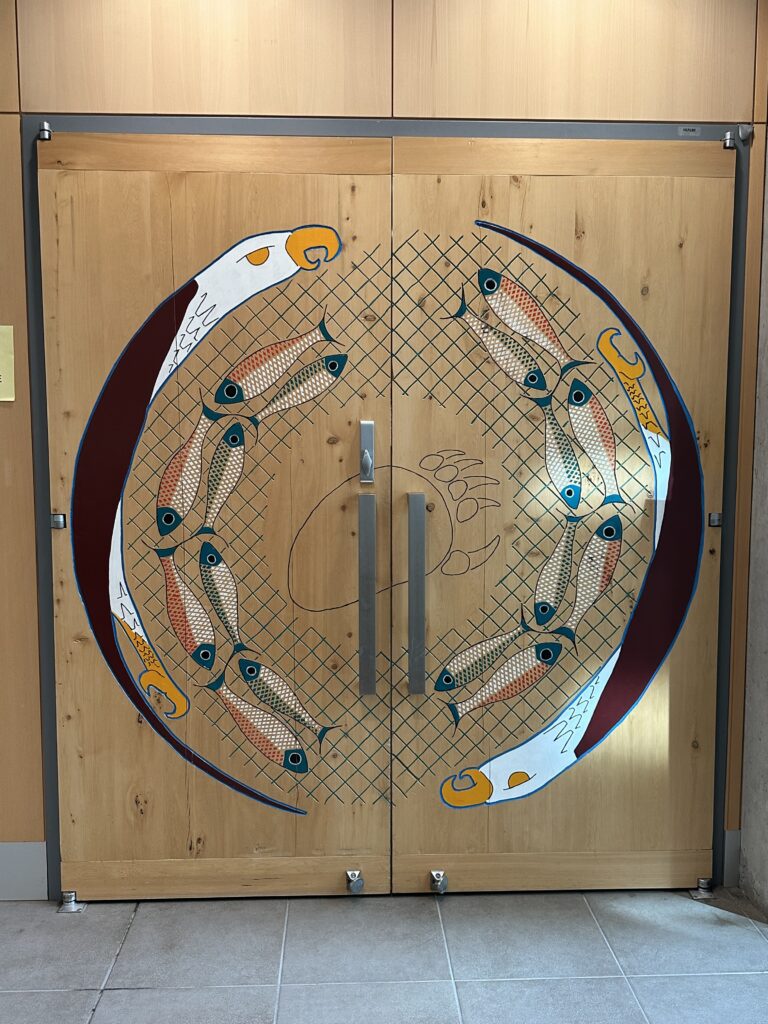
Carved Wood Doors
Carved doors at the entrance to the pit house-style conference room. Feature eagles that are sacred to the Sewépemc and salmon that are an important food source. The carved double doors depict the life cycle of the salmon, with the fish moving counterclockwise and eagles moving clockwise.
Artist Saul Terry (St’at’imc territory near Lillooet)
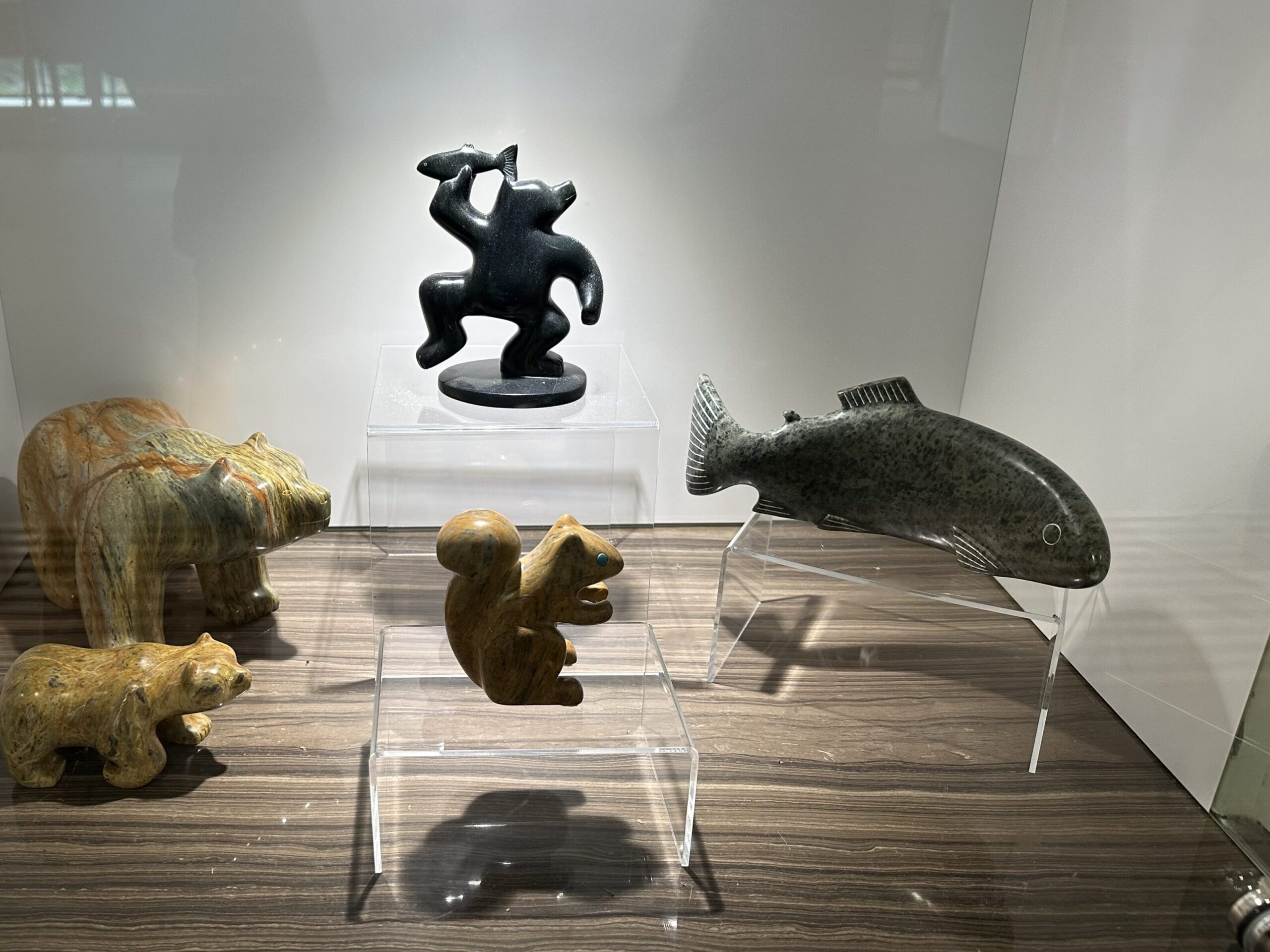
KPMG Gallery HL 1st floor.
Big Bear, Little Bear, Dancing Bear, Fish, and a carved squirrel.
Artist Charles Brown
Second Floor
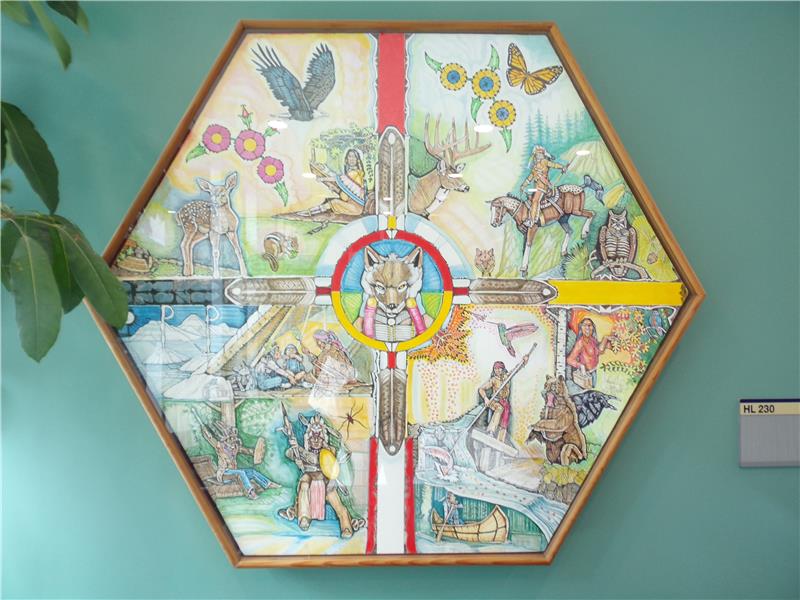
Wall Drum
The white, red, black, and yellow represent the four colours of humankind working together to protect and care for the earth. The feathers help move the air and carry our prayers to the Creator and offer protection.
Artist Dave Seymour (Secwépemc)
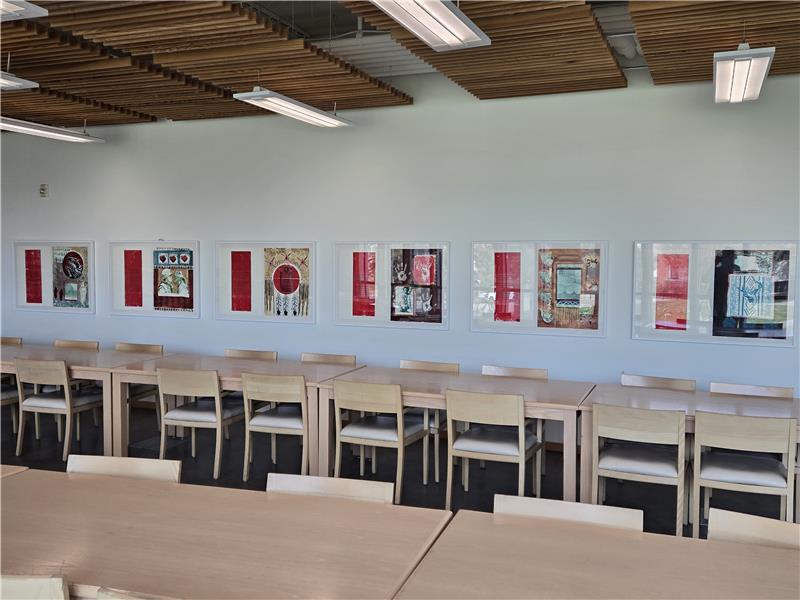
Coyote and the People Killer
“Coyote and the People Killer,” told by Isaac Willard and recorded by anthropologists, is reinterpreted by Tania Willard through illustration as a form of reclaiming the story.
Artist Tania Willard (Mixed Secwépemc and Settler)
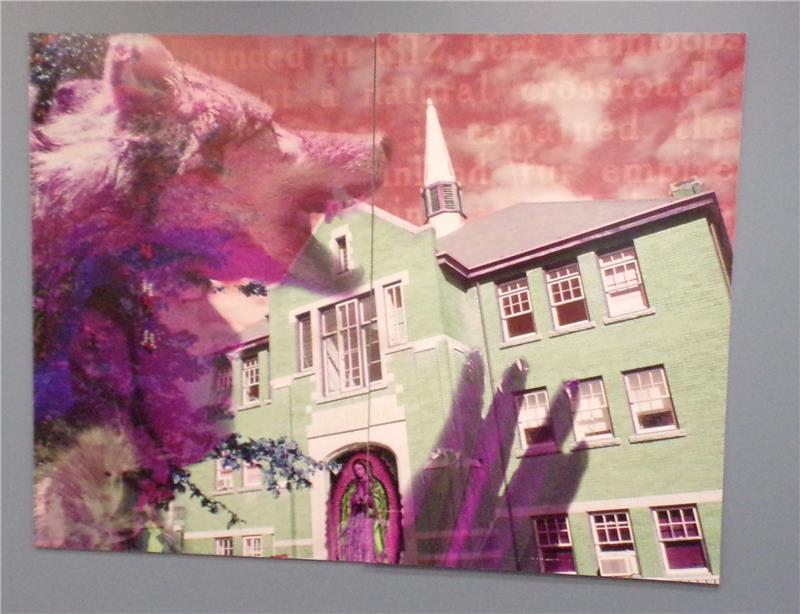
“Skelep Warrior b4 rez school” or “Forgive us Skelep School”.
Artist Chris Bose (Secwépemc and Nlaka’pamux)
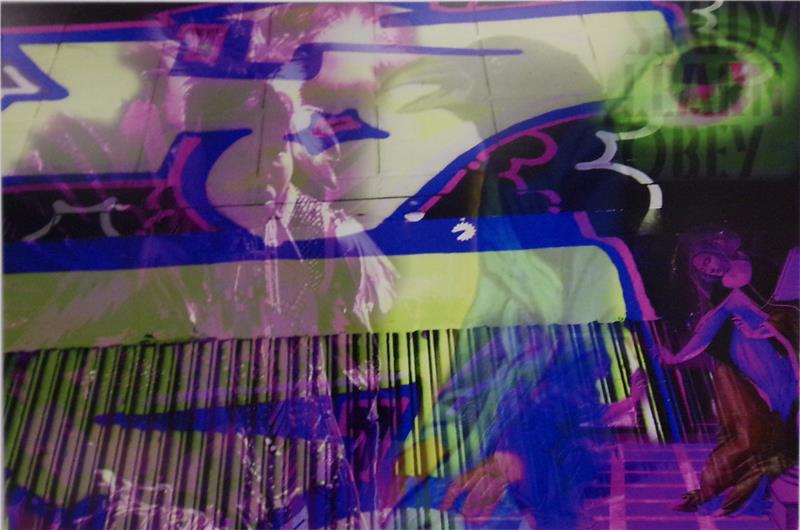
“Study, Learn, Obey”
This artwork is based on stained glass in churches, but street style with a graffiti background and super-saturated colours. Repurposing and retelling stories and history, but including Aboriginal people in it. A lot of my art is based on dreams and nightmares I have. The colours are super saturated because the dream state doesn’t bend to reality.
Artist Chris Bose (Secwépemc and Nlaka’pamux)
Third Floor
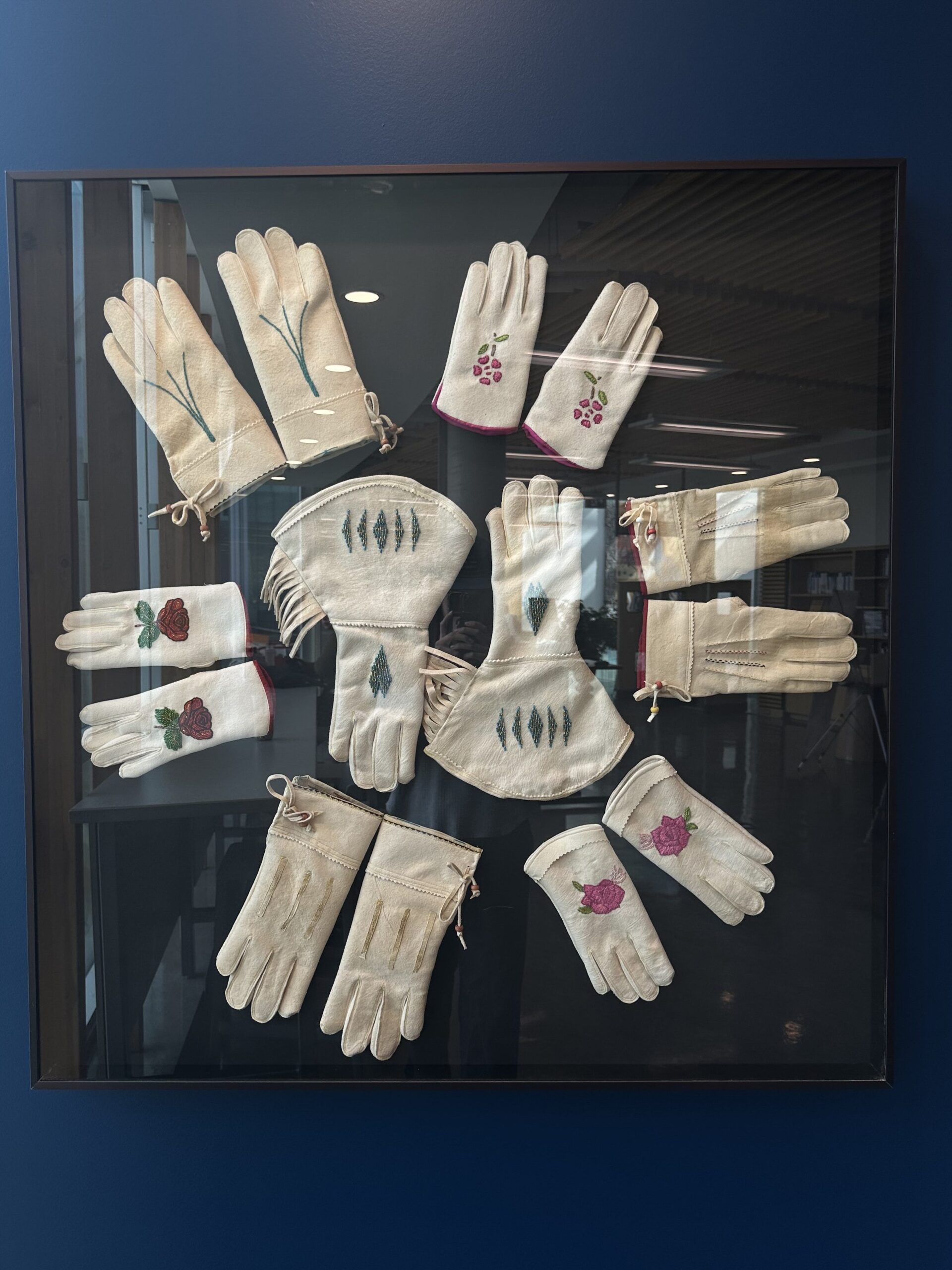
Beaded Gloves
Artist Nancy Saddleman (Upper Nicola Band)
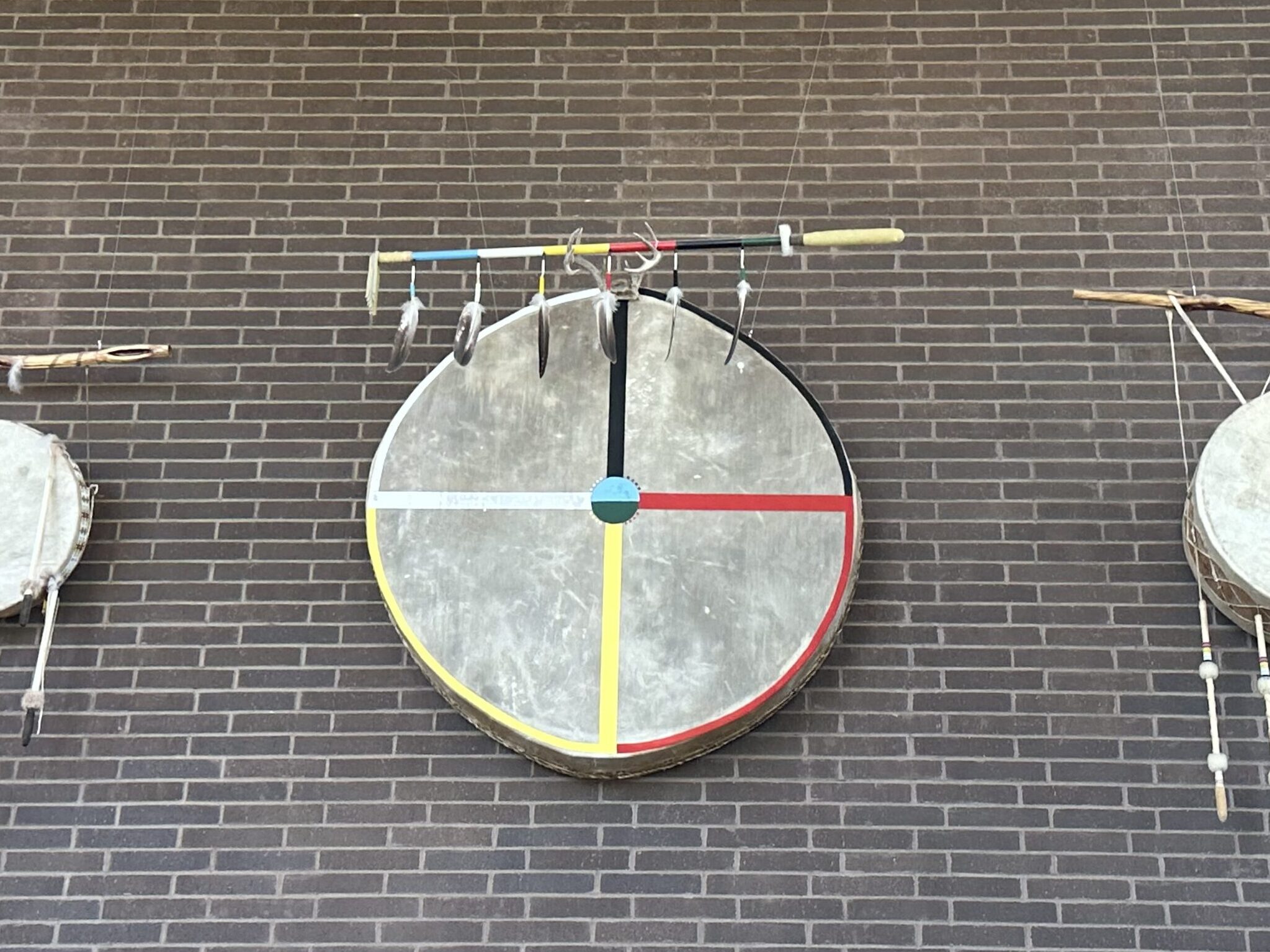
Moosehide Drum
Artist Deanna Nyce
Old Main
Taking a cue from the surrounding Mount Peter and Mount Paul, sacred to Tkemlúps te Secepemc, an undulating roofline makes a bold connection with the landscape. Built of prefabricated timber roof panels, the curvature of the roof also serves to unify the east and west wings of the new floors, previously bisected with a service zone. The Old Main addition succeeds by harmonizing landscape, culture, materiality and architecture.
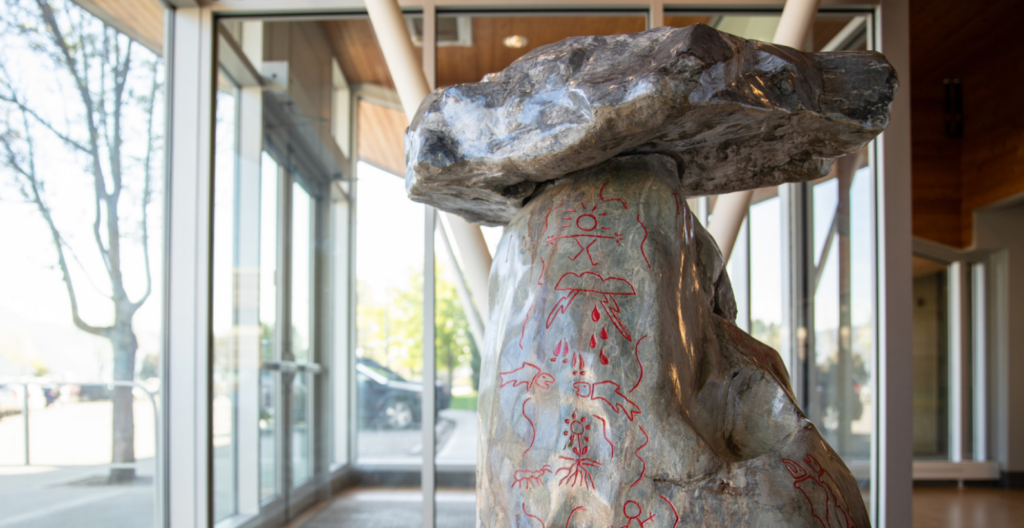
Secwépemc Territorial Marker
First floor, North entrance to Old Main, where the glassed-in elevator climbs to the fourth floor.
This territorial marker honours the deep connection between the Secwépemc people and their traditional lands. Created by local Secwépemc artists Rod and Ron Tomma and Mike Peters, the quartz marker at Old Main’s north entrance features pictographs and symbolizes places of cultural and mythological significance. The marker serves to inspire respect for the land and TRU’s partnership with Indigenous communities, with its unveiling including gifts from law graduates and a blessing by Elder Evelyn Camille.
OLARA
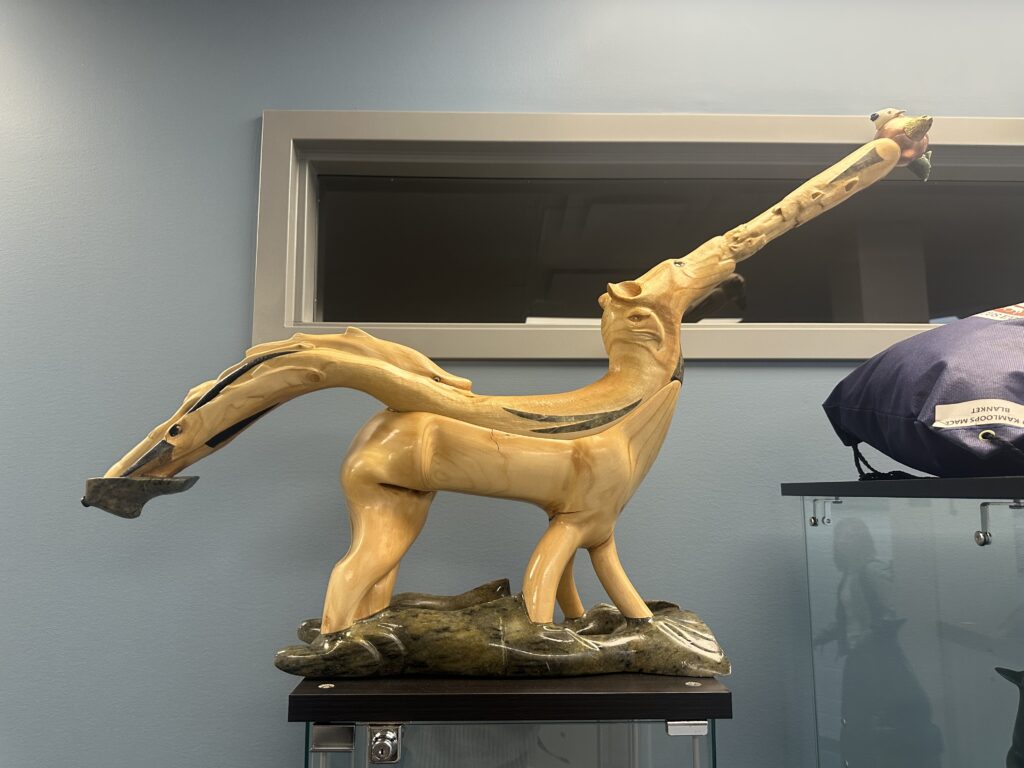
Old Ceremonial Mace
The ceremonial mace once symbolized authority and protection, but today it represents the university and is carried by the registrar during academic ceremonies.
Made from local spruce and set on a soapstone base shaped like spawning salmon, it forms an abstract wolf, symbolizing communication and learning. The copper head represents the sun and moon and features four animals connected to the medicine wheel, representing seasons, directions, and aspects of life. Additional carvings include animals such as the heron, frog, coyote, eagle, bear, and fish.
Artist Tom Daniel (St’at’imc Nation)
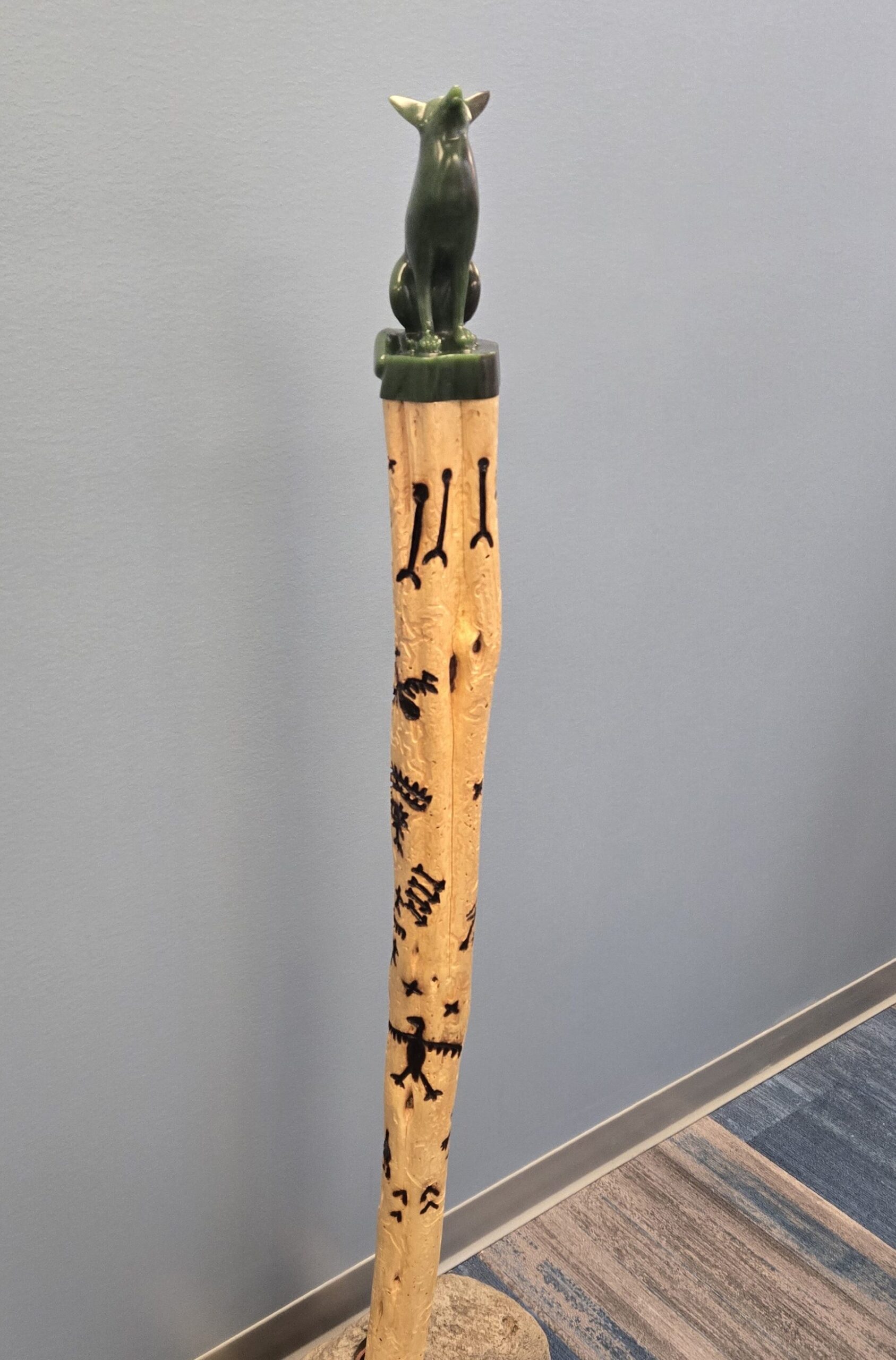
New Ceremonial Mace
A new ceremonial mace features Coyote (Skelep), a key figure in Secwépemc culture who created space for humans to live and learn. The jade carving of Coyote sits atop a juniper staff engraved with pictographs that tell Secwépemc stories, symbolizing Coyote as a guardian of these teachings.
The jade, sourced from northern B.C., was shaped and polished to glow, while the juniper, an important medicinal wood, was carved and marked with red ochre to highlight the stories. The mace represents cultural knowledge, storytelling, and connection to the land.
Artist Ed Jensen (Secwépemc)
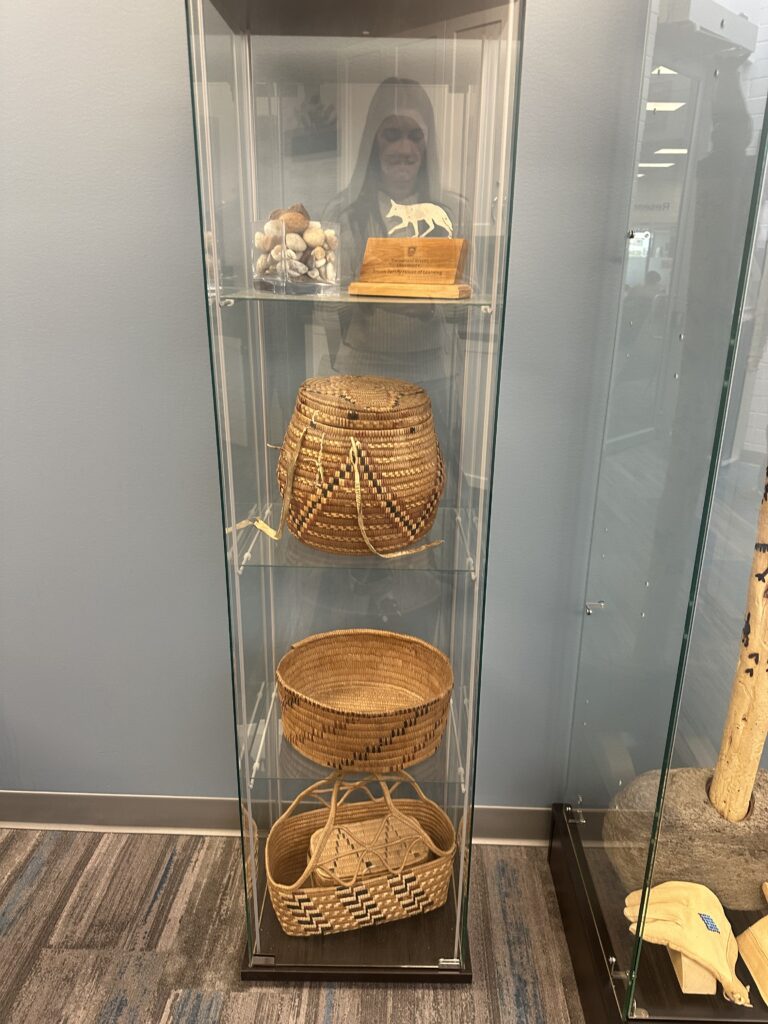
Assortment of Baskets

Research and Emergency Management Building
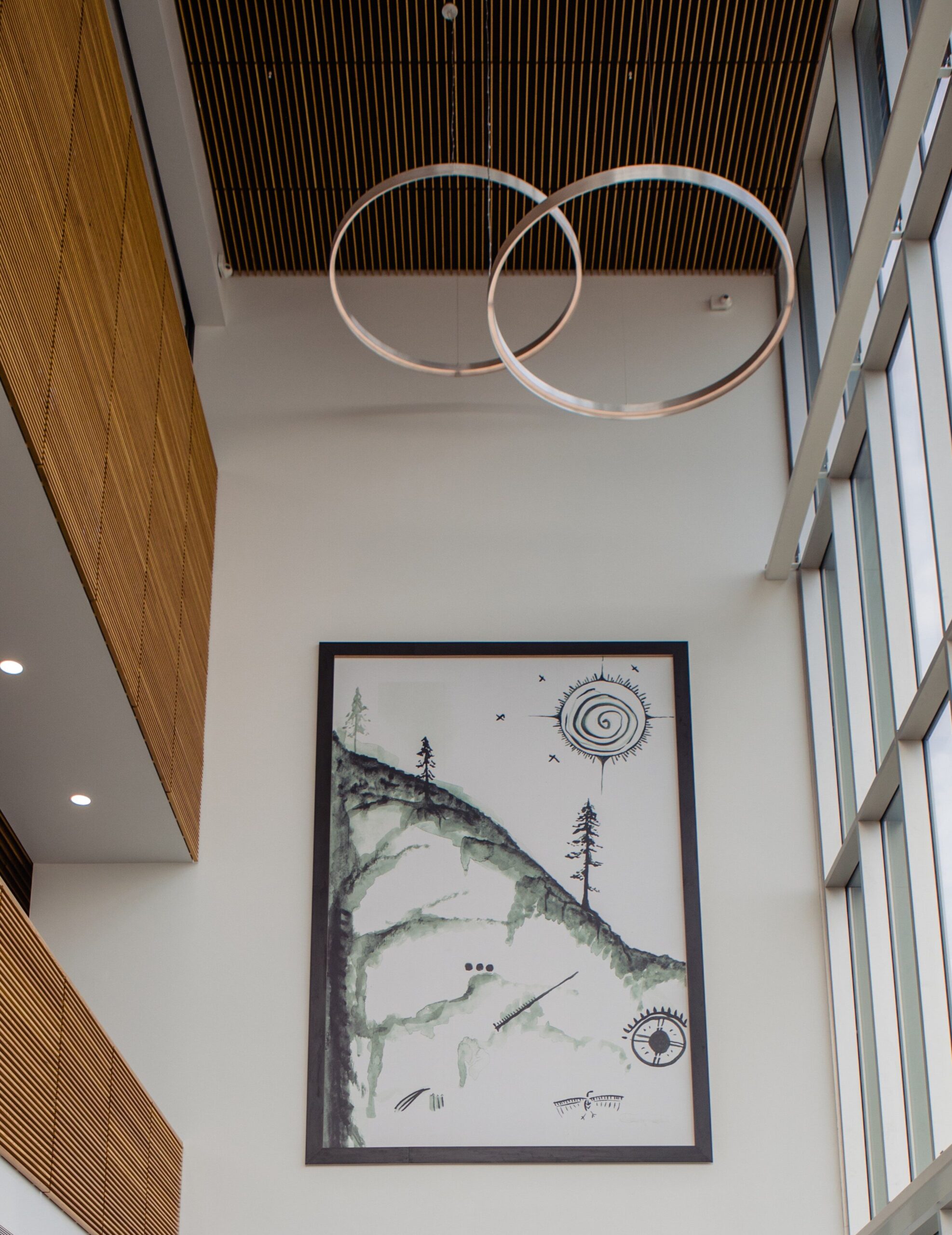
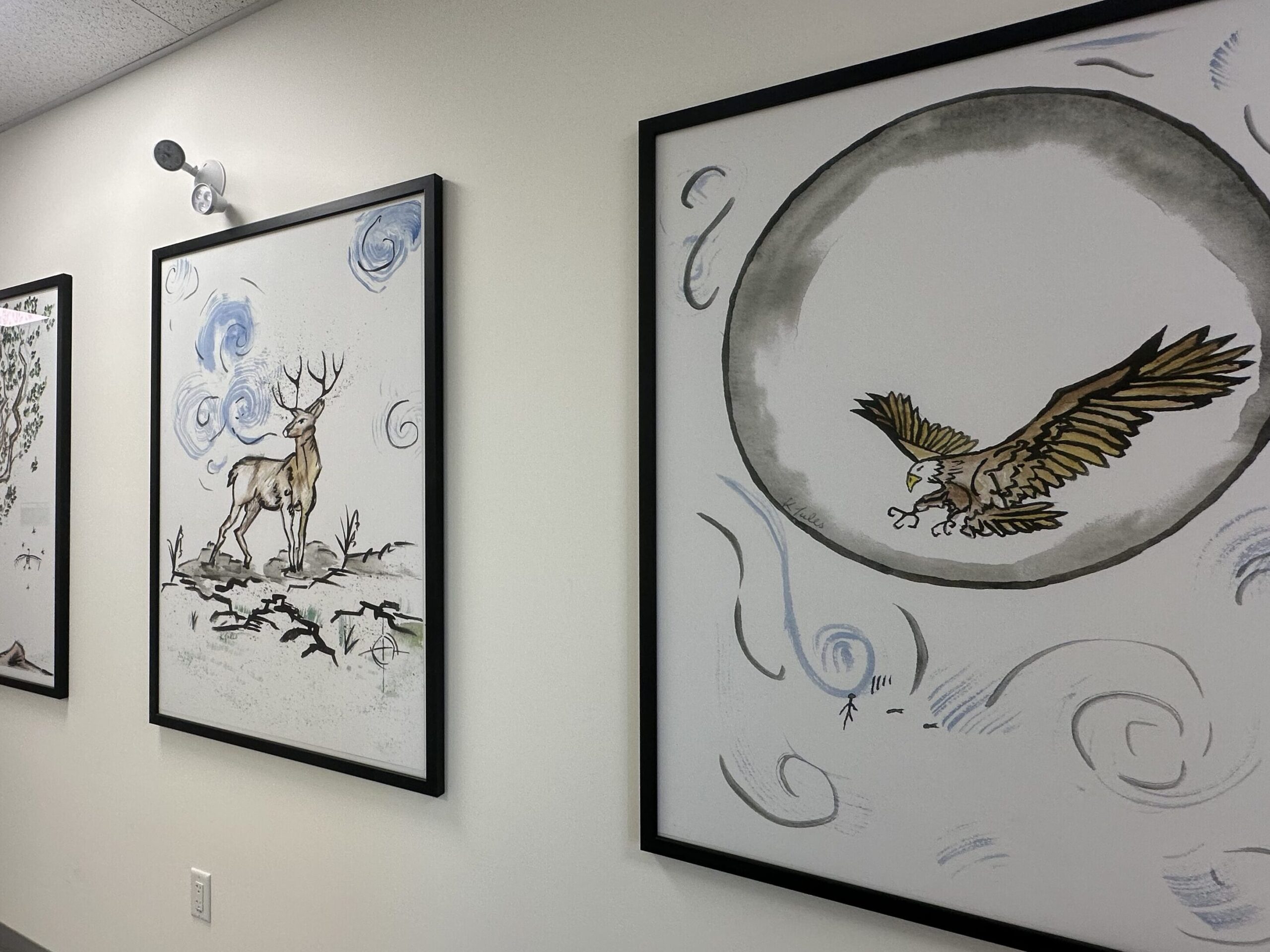
Cmeśekst – The Four Winds
My artwork intertwines elements of Tk’emlúps te Secwépeme stories and imagery of local animals with a plea for forestry preservation, depicted on a grand scale. The salmon, a revered symbol in indigenous culture, embodies resilience and interconnectedness through the creation legend, weaving through the narrative alongside a Tsrep (tree), my rendition of the tree of life, Tśi7 (deer), who gives us warmth and nourishment, and Spelqwégs (Eagle), our messenger to tqeltkúkwpi7 (Creator). These symbols speak to the harmony of nature and the sacred balance within the Tk’emlúps tradition. My art here emphasizes the fragility of our ecosystems and the urgent need for preservation. The intricate details of the natural world serve as a reminder of our interconnectedness and our responsibility as stewards of the earth. Through my art, I aim to ignite a sense of reverence and advocacy, urging viewers to protect these vital habitats for generations to come and to honour both Indigenous heritage and nature’s enduring spirit.
Artist Kel-C (Kelsey) Jules


Industrial Training and Technology Building
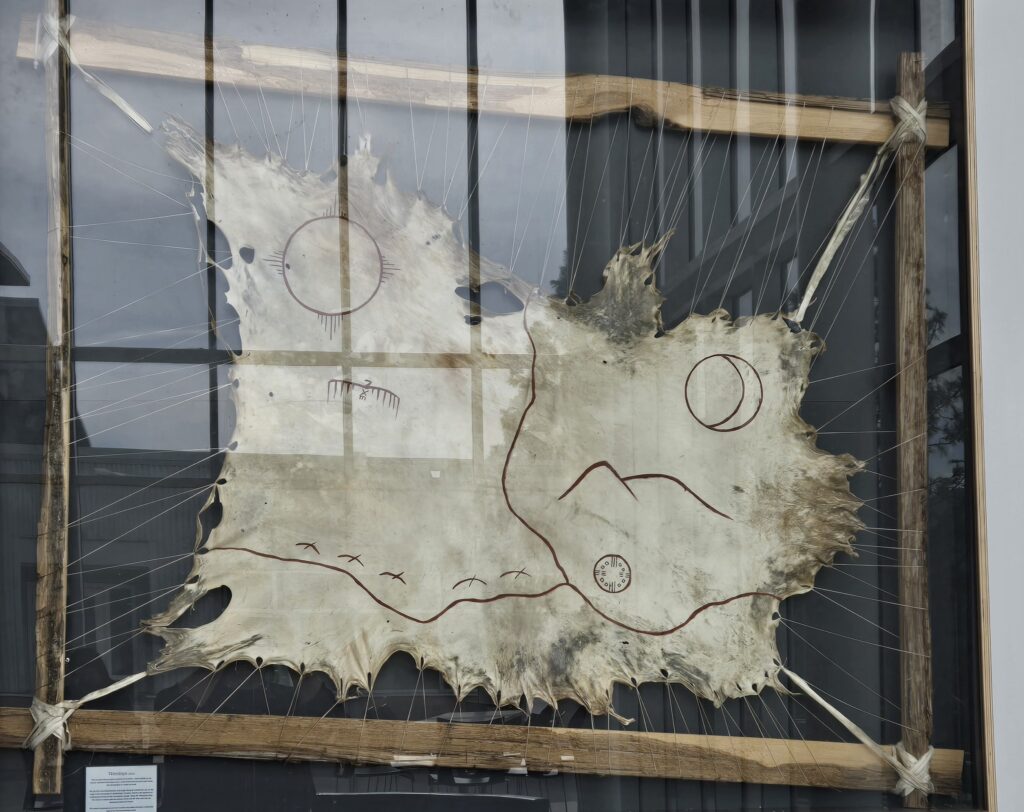
Tkemlúps (2021)
This art piece was created to represent my home. I used rawhide as my canvas, stretched with sinew over a cedar frame and red ochre paint, along with pictographs, to create my work. The top left is my interpretation of an eagle flying up towards the sun, as the eagle is the messenger to Tqeltkúkwpi7 (creator). Below is the depiction of traditional pit homes of the Secepemc people along the Thompson River. The arbour is shown with the warrior shield, and Mt Peter and Paul are shown just below the moon. This work is important to me since it shows my culture through a traditional style of art that my ancestors used
Kelsey Jules is a Secwépemc and Syilx artist, model, and teacher. She is a member of Tk’emlups te Secwepemc. “I have a love for creating illustrations and for the arts. I attended Thompson Rivers University for the Bachelor of Fine Arts. Creativity comes in all forms. I began modelling for Fashion Speaks International, an agency that focuses on Indigenous models and designers to create awareness for missing and murdered indigenous women/people. The agency helps to boost careers and create a supportive community. Being surrounded by international Indigenous designers has opened my mind to even more potential creative ideas. “I am currently an Aboriginal Education Worker for School District 73. I am very lucky to help students with their academic needs. I have been teaching all students the Secwépemc language, culture and art. I strongly encourage my students to continue any creative outlets they might have and I love teaching them new techniques that they can try.”
Artist Kel-C (Kelsey) Jules